Menstruation (Haydh) is Harmful (Atha)
Allah, the Most Exalted, has prohibited men from engaging in sexual intercourse with their wives at the time of menstruation (Haydh).
The Holy Quran clearly stated that the reason for this prohibition is that menstruation is harmful (Atha). Allah, the Most Exalted, says:
"And they ask you about menstruation. Say, 'It is harm, so keep away from wives during menstruation. And do not approach them until they are pure. And when they have purified themselves, then come to them from where Allah has ordained for you. Indeed, Allah loves those who are constantly repentant and loves those who purify themselves.'" Surah Al-Baqarah (02:222)
Menstruation (al-Haydh) is the blood that usually discharged by a healthy (normal) woman from the womb to the outside, often in regular periods, and emerging through the vagina (the usual exit). It is often characterized by the following: being red or black, hot, thick (viscous), and exiting with a gush and a burning sensation. Through these characteristics, Haydh (menstrual) blood can be distinguished from other types of blood.
GENERAL CONDITIONS:
1. Puberty (al-Bulugh)
Menstruation is considered a sign of religious puberty (Bulugh Shar'i) if the blood emerges after a girl has completed nine lunar years. Blood that appears before the completion of nine lunar years is not counted as Haydh.
2. Not Reaching Menopause
Menopause (al-Ya's) begins upon completing fifty lunar years (which is approximately 48 Gregorian years and 7 months and a half). This ruling applies to all women (whether from Quraysh or otherwise). However, for a Quarshie woman who continues to see blood meeting the conditions of Haydh until sixty lunar years, the recommended precaution (al-Afdal) is to combine the actions of a woman in Istihadah (non-menstrual bleeding) with the obligations of a menstruating woman (i.e., refraining from what a menstruating woman refrains from). Otherwise, she is considered to be in the state of Istihadah.
3. The Blood Must Emerge
Haydh is ruled only when the blood emerges (exits) from the vagina. If it remains inside the inner part of the vagina, it is not given the ruling of Haydh. Whenever a woman feels blood leaving the womb, but it has not emerged to the outside, she is not obliged to insert cotton for inspection but may follow the rules of a purified woman until the blood emerges on its own. However, it is better (al-Afdal) for her to inspect herself in this situation.
4. Coincidence with Habit or Characteristics
The emerging blood must coincide with either of the following, depending on the woman's state:
- a. The blood coincides with the fixed time of her regular period.
- b. The blood possesses the characteristics of Haydh blood (for women who do not have a fixed time for their period).
5. The Period of Flowing (Duration)
The period of flow must not be less than three days and must not exceed ten days.
- a. Minimum Duration: It must not be less than three days. If it stops before three full days (present for 72 consecutive hours), it is not considered Haydh.
- b. Maximum Duration: It must not exceed ten days.
6. Minimum Interval Between Two Periods
A minimum of ten days must separate the end of one Haydh and the start of the next. If a woman sees blood before the ten-day interval following her previous Haydh is complete, that blood is not considered Haydh; rather, she must treat it as Istihadah.
7. The Blood Must Not be from a wound or ulcer
The blood must not result from a wound, an ulcer (caused by illness), or the rupture of the hymen (deflowering a virgin).
CATEGORIES OF WOMEN AND THEIR RULINGS
The women are categorized based on the stability of their menstrual habit (‘Adah):
1- Fixed Time (Waqtiyyah) and Duration (Adadiyyah): Regular in both its start time and the number of bleeding days.
2- Fixed Time-Only (Waqtiyyah): Regular in its start time, but the duration varies.
3- Fixed Duration-Only (Adadiyyah): Regular in the number of days, but the start time varies.
4- The Irregular Woman (Mudtaribah): Previously had a habit, but it is no longer stable or consistent.
5- The Forgetful Woman (Nasiyat al-Iddah): she cannot recall the time or the duration of her previous habit.
6- The Beginner (Mubtadi'ah): She sees blood for the first time in her life.
THE RULINGS OF THE BEGINNER (MUBTADI’AH) AND
THE IRREGULAR WOMAN (MUDTARIBAH)
She considers the blood to be Haydh if it meets the necessary conditions, primarily flowing for not less than 3 days and not more than 10 days and possessing the characteristics of Haydh blood.
The Beginner (Mubtadi’ah) must seek guidance from her female relatives' habits – her mother, grandmothers, aunts (from her father’s and mother’s side), cousins (from her father’s and mother’s side) and the like. If
- Relatives Share a Single Habit: She follows their single, consistent duration as her Haydh days and deems the rest as Istihadah.
- Relatives Have Differing Habits (or None):
- First Month: She has the choice to consider her period as lasting six or seven days (common durations). Up to the tenth day, she must combine the acts of the Mustahadah and Haydh leave.
- Subsequent Months: She deems the first three days as Haydh with certainty. She must then observe the obligatory precaution and combine the acts of Mustahadah and Haydh leave up to the sixth or seventh day. She deems any blood seen after the sixth or seventh day as Istihadah.
- She must follow this ruling until her period becomes stable.
The Irregular Woman (Mudtaribah)
She does not refer to the habits of her female relatives. She should consider her period to be six or seven days and deem the remaining days up to the tenth as Istihadah.
RULINGS FOR THE WOMAN WITH A REGULAR PERIOD
1. The Rulings When Bleeding Stays Within the 10-Day Limit
The woman with a regular period considers herself to be in the state of Haydh for the duration of her habit, regardless of the blood's characteristics, so long as the bleeding does not exceed ten days overall.
2. The Rulings When Bleeding Exceeds the 10-Day Limit
A. Fixed Time and Duration: She must deem her habitual number of days as Haydh, and everything seen afterward (up to the tenth day) as Istihadah.
B. Fixed Time-Only: If the flow exceeds 10 days, she must refer to the characteristics of the blood:
- If the blood has Haydh characteristics and the flow is within her usual time, it is Haydh.
- If the blood does not have Haydh characteristics, it is Istihadah.
- Note: If the blood started earlier or later by one or two days, she follows the same rule as long as the majority of the period falls within the habitual time.
C. Fixed Duration-Only: She must distinguish the state of the blood based on its characteristics, since the time is not fixed:
- All Blood has Haydh Characteristics: If the flow exceeds her regular duration and continues past 10 days, she must rely on the Haydh characteristics (distinction) to determine the duration of her Haydh, and the rest is Istihadah.
- All Blood has Istihadah Characteristics: All of the bleeding is deemed Istihadah.
- Blood Varies in Characteristics: She considers the blood with Haydh characteristics to be Haydh (provided it meets all the general conditions) and the blood with Istihadah characteristics to be Istihadah.
THE WOMAN WHO FORGETS HER PERIOD
1. The Woman Who Forgets Her Duration (Duration-Only Habit)
If her period was fixed only by duration (‘Adadiyyah) but she now forgets the number of days, she must rely on the blood characteristics (distinction) for her judgment:
- If bleeding is within the 10-Day Limit: She deems the blood having Haydh characteristics as Haydh and that having Istihadah characteristics as Istihadah.
- If bleeding exceeds the 10-Day Limit:
- Strong Supposition: If she has a strong supposition (Zann) of a certain duration (e.g., five days), she acts upon it, deeming those days as Haydh and the rest as Istihadah.
- Supposition exceeds 7 Days: If she supposes her duration is more than seven days (up to 10), she must observe the obligatory precaution by combining the acts of the Mustahadah with the obligations of Haydh leave during the days that exceed seven days (up to the 10th day).
2. The Woman Who Forgets Her Time (Time-Only Habit)
If her period was fixed only by time (Waqtiyyah) but she now forgets the specific day it started, she also relies on blood distinction if the flow is less than or equal to 10 days.
- If bleeding is 10 days or less:
- Possibility 1: Known Time Window: If she knows the period must have occurred within a known time window (e.g., 13 days), she must observe the obligatory precaution by combining the acts of Istihadah and Haydh leave throughout the entire known window.
- Possibility 2: Unknown Time Window:
- If the characteristics vary, she deems the blood with Haydh characteristics as Haydh (if it is not less than 3 days and not more than 10 days).
- If the characteristics are uniformly Haydh, she reverts to the common duration, deeming 6 or 7 days as Haydh.
- If the characteristics are uniformly Istihadah, all of it is considered Istihadah.
3. The Woman Who Forgets Both Time and Duration
This woman had a Fixed Time and Duration habit but forgot one or both details.
a) Forgets Time, Remembers Duration:
Her ruling is generally that of the Time-Only Forgotten woman, except that if the bleeding exceeds 10 days, she must apply her remembered duration to cut off the Haydh.
b) Forgets Duration, Remembers Time:
She deems the first three days of the flow at her habitual time as Haydh with certainty. She then uses characteristics up to the 10th day. If the flow exceeds 10 days, her ruling reverts to that of the Duration-Only Forgotten woman (relying on supposition of 6 or 7 days).
c) Forgets Both Time and Duration:
o If bleeding is 10 days or less: She deems all blood with Haydh characteristics as Haydh.
o If bleeding is more than 10 days:
- Known General Timeframe: If she knows the days generally coincide with her period, she must observe the obligatory precaution by combining the acts of Istihadah and Haydh leave (as observing the time is more decisive than the duration).
- Absence of General Timeframe: She reverts to considering the duration aspect. She acts on her strong supposition of duration or otherwise deems her Haydh as 6 or 7 days (the ruling for the Duration-Only Forgotten woman).
Menstruation (Haydh) is Harmful (Atha)
Allah, the Most Exalted, has prohibited men from engaging in sexual intercourse with their wives at the time of menstruation (Haydh).
The Holy Quran clearly stated that the reason for this prohibition is that menstruation is harmful (Atha). Allah, the Most Exalted, says:
"And they ask you about menstruation. Say, 'It is harm, so keep away from wives during menstruation. And do not approach them until they are pure. And when they have purified themselves, then come to them from where Allah has ordained for you. Indeed, Allah loves those who are constantly repentant and loves those who purify themselves.'" Surah Al-Baqarah (02:222)
Menstruation (al-Haydh) is the blood that usually discharged by a healthy (normal) woman from the womb to the outside, often in regular periods, and emerging through the vagina (the usual exit). It is often characterized by the following: being red or black, hot, thick (viscous), and exiting with a gush and a burning sensation. Through these characteristics, Haydh (menstrual) blood can be distinguished from other types of blood.
GENERAL CONDITIONS:
1. Puberty (al-Bulugh)
Menstruation is considered a sign of religious puberty (Bulugh Shar'i) if the blood emerges after a girl has completed nine lunar years. Blood that appears before the completion of nine lunar years is not counted as Haydh.
2. Not Reaching Menopause
Menopause (al-Ya's) begins upon completing fifty lunar years (which is approximately 48 Gregorian years and 7 months and a half). This ruling applies to all women (whether from Quraysh or otherwise). However, for a Quarshie woman who continues to see blood meeting the conditions of Haydh until sixty lunar years, the recommended precaution (al-Afdal) is to combine the actions of a woman in Istihadah (non-menstrual bleeding) with the obligations of a menstruating woman (i.e., refraining from what a menstruating woman refrains from). Otherwise, she is considered to be in the state of Istihadah.
3. The Blood Must Emerge
Haydh is ruled only when the blood emerges (exits) from the vagina. If it remains inside the inner part of the vagina, it is not given the ruling of Haydh. Whenever a woman feels blood leaving the womb, but it has not emerged to the outside, she is not obliged to insert cotton for inspection but may follow the rules of a purified woman until the blood emerges on its own. However, it is better (al-Afdal) for her to inspect herself in this situation.
4. Coincidence with Habit or Characteristics
The emerging blood must coincide with either of the following, depending on the woman's state:
- a. The blood coincides with the fixed time of her regular period.
- b. The blood possesses the characteristics of Haydh blood (for women who do not have a fixed time for their period).
5. The Period of Flowing (Duration)
The period of flow must not be less than three days and must not exceed ten days.
- a. Minimum Duration: It must not be less than three days. If it stops before three full days (present for 72 consecutive hours), it is not considered Haydh.
- b. Maximum Duration: It must not exceed ten days.
6. Minimum Interval Between Two Periods
A minimum of ten days must separate the end of one Haydh and the start of the next. If a woman sees blood before the ten-day interval following her previous Haydh is complete, that blood is not considered Haydh; rather, she must treat it as Istihadah.
7. The Blood Must Not be from a wound or ulcer
The blood must not result from a wound, an ulcer (caused by illness), or the rupture of the hymen (deflowering a virgin).
CATEGORIES OF WOMEN AND THEIR RULINGS
The women are categorized based on the stability of their menstrual habit (‘Adah):
1- Fixed Time (Waqtiyyah) and Duration (Adadiyyah): Regular in both its start time and the number of bleeding days.
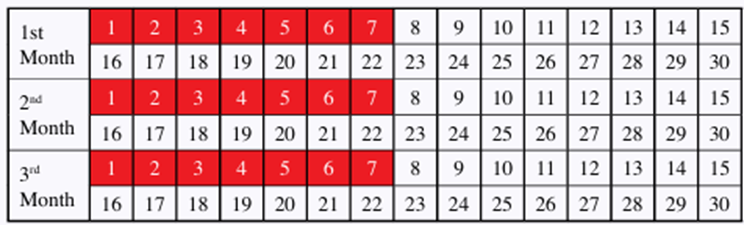
2- Fixed Time-Only (Waqtiyyah): Regular in its start time, but the duration varies.
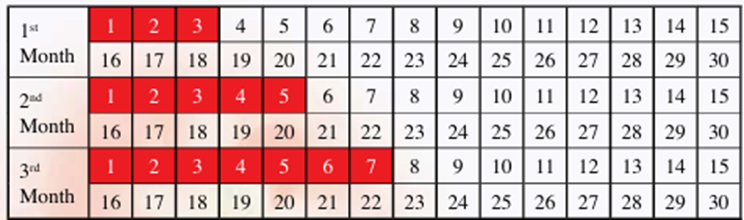
3- Fixed Duration-Only (Adadiyyah): Regular in the number of days, but the start time varies.
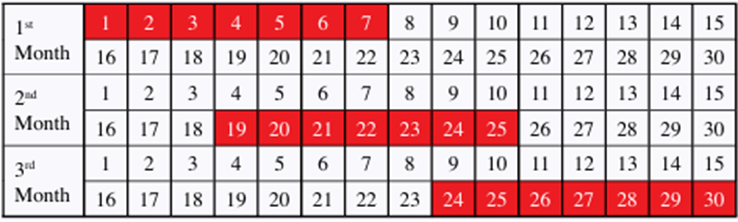
4- The Irregular Woman (Mudtaribah): Previously had a habit, but it is no longer stable or consistent.
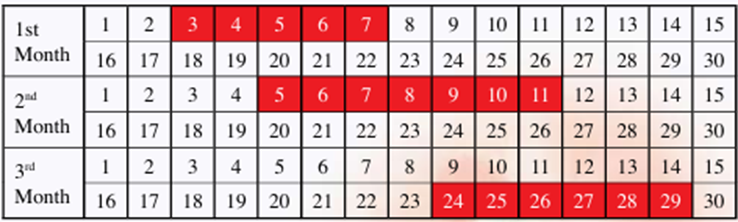
5- The Forgetful Woman (Nasiyat al-Iddah): she cannot recall the time or the duration of her previous habit.
6- The Beginner (Mubtadi'ah): She sees blood for the first time in her life.
THE RULINGS OF THE BEGINNER (MUBTADI’AH) AND
THE IRREGULAR WOMAN (MUDTARIBAH)
She considers the blood to be Haydh if it meets the necessary conditions, primarily flowing for not less than 3 days and not more than 10 days and possessing the characteristics of Haydh blood.
The Beginner (Mubtadi’ah) must seek guidance from her female relatives' habits – her mother, grandmothers, aunts (from her father’s and mother’s side), cousins (from her father’s and mother’s side) and the like. If
- Relatives Share a Single Habit: She follows their single, consistent duration as her Haydh days and deems the rest as Istihadah.
- Relatives Have Differing Habits (or None):
- First Month: She has the choice to consider her period as lasting six or seven days (common durations). Up to the tenth day, she must combine the acts of the Mustahadah and Haydh leave.
- Subsequent Months: She deems the first three days as Haydh with certainty. She must then observe the obligatory precaution and combine the acts of Mustahadah and Haydh leave up to the sixth or seventh day. She deems any blood seen after the sixth or seventh day as Istihadah.
- She must follow this ruling until her period becomes stable.
The Irregular Woman (Mudtaribah)
She does not refer to the habits of her female relatives. She should consider her period to be six or seven days and deem the remaining days up to the tenth as Istihadah.
RULINGS FOR THE WOMAN WITH A REGULAR PERIOD
1. The Rulings When Bleeding Stays Within the 10-Day Limit
The woman with a regular period considers herself to be in the state of Haydh for the duration of her habit, regardless of the blood's characteristics, so long as the bleeding does not exceed ten days overall.
2. The Rulings When Bleeding Exceeds the 10-Day Limit
A. Fixed Time and Duration: She must deem her habitual number of days as Haydh, and everything seen afterward (up to the tenth day) as Istihadah.
B. Fixed Time-Only: If the flow exceeds 10 days, she must refer to the characteristics of the blood:
- If the blood has Haydh characteristics and the flow is within her usual time, it is Haydh.
- If the blood does not have Haydh characteristics, it is Istihadah.
- Note: If the blood started earlier or later by one or two days, she follows the same rule as long as the majority of the period falls within the habitual time.
C. Fixed Duration-Only: She must distinguish the state of the blood based on its characteristics, since the time is not fixed:
- All Blood has Haydh Characteristics: If the flow exceeds her regular duration and continues past 10 days, she must rely on the Haydh characteristics (distinction) to determine the duration of her Haydh, and the rest is Istihadah.
- All Blood has Istihadah Characteristics: All of the bleeding is deemed Istihadah.
- Blood Varies in Characteristics: She considers the blood with Haydh characteristics to be Haydh (provided it meets all the general conditions) and the blood with Istihadah characteristics to be Istihadah.
THE WOMAN WHO FORGETS HER PERIOD
1. The Woman Who Forgets Her Duration (Duration-Only Habit)
If her period was fixed only by duration (‘Adadiyyah) but she now forgets the number of days, she must rely on the blood characteristics (distinction) for her judgment:
- If bleeding is within the 10-Day Limit: She deems the blood having Haydh characteristics as Haydh and that having Istihadah characteristics as Istihadah.
- If bleeding exceeds the 10-Day Limit:
- Strong Supposition: If she has a strong supposition (Zann) of a certain duration (e.g., five days), she acts upon it, deeming those days as Haydh and the rest as Istihadah.
- Supposition exceeds 7 Days: If she supposes her duration is more than seven days (up to 10), she must observe the obligatory precaution by combining the acts of the Mustahadah with the obligations of Haydh leave during the days that exceed seven days (up to the 10th day).
2. The Woman Who Forgets Her Time (Time-Only Habit)
If her period was fixed only by time (Waqtiyyah) but she now forgets the specific day it started, she also relies on blood distinction if the flow is less than or equal to 10 days.
- If bleeding is 10 days or less:
- Possibility 1: Known Time Window: If she knows the period must have occurred within a known time window (e.g., 13 days), she must observe the obligatory precaution by combining the acts of Istihadah and Haydh leave throughout the entire known window.
- Possibility 2: Unknown Time Window:
- If the characteristics vary, she deems the blood with Haydh characteristics as Haydh (if it is not less than 3 days and not more than 10 days).
- If the characteristics are uniformly Haydh, she reverts to the common duration, deeming 6 or 7 days as Haydh.
- If the characteristics are uniformly Istihadah, all of it is considered Istihadah.
3. The Woman Who Forgets Both Time and Duration
This woman had a Fixed Time and Duration habit but forgot one or both details.
a) Forgets Time, Remembers Duration:
Her ruling is generally that of the Time-Only Forgotten woman, except that if the bleeding exceeds 10 days, she must apply her remembered duration to cut off the Haydh.
b) Forgets Duration, Remembers Time:
She deems the first three days of the flow at her habitual time as Haydh with certainty. She then uses characteristics up to the 10th day. If the flow exceeds 10 days, her ruling reverts to that of the Duration-Only Forgotten woman (relying on supposition of 6 or 7 days).
c) Forgets Both Time and Duration:
o If bleeding is 10 days or less: She deems all blood with Haydh characteristics as Haydh.
o If bleeding is more than 10 days:
- Known General Timeframe: If she knows the days generally coincide with her period, she must observe the obligatory precaution by combining the acts of Istihadah and Haydh leave (as observing the time is more decisive than the duration).
- Absence of General Timeframe: She reverts to considering the duration aspect. She acts on her strong supposition of duration or otherwise deems her Haydh as 6 or 7 days (the ruling for the Duration-Only Forgotten woman).